Figure AI Helix 2.5: Zero-Shot Humanoid Manipulation Is Here
by @mominmikhail4 views0 downloadsOct 2, 2026, 05:31
Keywords
Figure AI Helix 2.5zero-shot humanoid manipulationvision-language-action model roboticsFigure AI foundation modelbimanual dexterity humanoidsrobot teleoperation replacementVLA architectureend-to-end foundation modelszero-shot physical manipulationembodied intelligencebimanual coordinationteleoperation data collectiongeneral-purpose humanoids
Video Script / Transcript
Figure AI just wiped out humanoid training with Helix 2.5.
If your automation strategy relies on paying engineers to wear VR headsets for twelve hours a day just to pick up a single bolt, I've got some uncomfortable news. Teleoperation data collection as we know it is officially dead.
For years, the dirty secret of humanoid robotics was the data bottleneck. Getting a bipedal robot to do anything meaningful meant recording thousands of teleoperated demonstrations, spending weeks fine-tuning policies for every task, and praying the lighting didn't change. Honestly, good riddance to that headache.
Helix 2.5 breaks that paradigm completely. It's an end-to-end Vision-Language-Action foundation model built specifically for zero-shot physical manipulation. It translates multimodal perception directly into continuous motor actions. You don't train it for your specific workstation. You just place the robot on the floor, give it a goal in natural language, and let the embodied intelligence take over.
Here's how this changes the game across three critical areas.
First, the teleoperation tax is gone. Traditional humanoid deployments demand an average of fifteen hundred teleoperated hours per task just to reach an acceptable reliability threshold. Helix 2.5 cuts human demonstration time down to zero. In recent enterprise benchmarks across forty novel manipulation tasks—from sorting unmodeled sheet metal components to handling irregular power tools—it delivered an eighty-eight percent first-attempt success rate without a single minute of site-specific fine-tuning.
Second, native bimanual dexterity at scale. Robots usually struggle with two-handed manipulation because traditional software stacks stitch together separate vision systems, motion planners, and kinematics solvers. The delay turns a simple handoff into a slow-motion disaster. Helix 2.5 runs on a unified transformer backbone operating at two hundred hertz. It coordinates both hands simultaneously, adjusting grip compliance within twelve milliseconds when managing dynamic, shifting loads like loose wiring harnesses or fluid-filled containers.
Third, deployment timelines are collapsing. Automation directors typically budget four to six months of systems integration for every new robotic cell. With Helix 2.5, transitioning a humanoid from de-palletizing bulk crates to precision mechanical assembly takes hours, not quarters. Because physical reasoning and spatial awareness are natively built in, facilities can repurpose general-purpose hardware on the fly, cutting deployment overhead by over sixty percent.
If you're still pouring capital into proprietary teleoperation rigs, you're essentially manufacturing telegraphs in the smartphone era.
Are zero-shot foundation models ready to take over your industrial floor tomorrow, or are specialized policies still necessary for mission-critical uptime? Share your perspective below, subscribe for deeper breakdowns into the future of physical AI, and let us know which workflow you'd automate first.
Related Creations
Explore AI creations on similar topics generated by the community

Figure AI's Helix 2.5 Just Solved Domestic Robotics
by @mominmikhail2026-09-24T07:11:15Z
18 views
Figure AI Helix 2.5: Zero-Shot Household Robotics Breakthrough
by @mominmikhail2026-09-21T12:57:08Z
13 views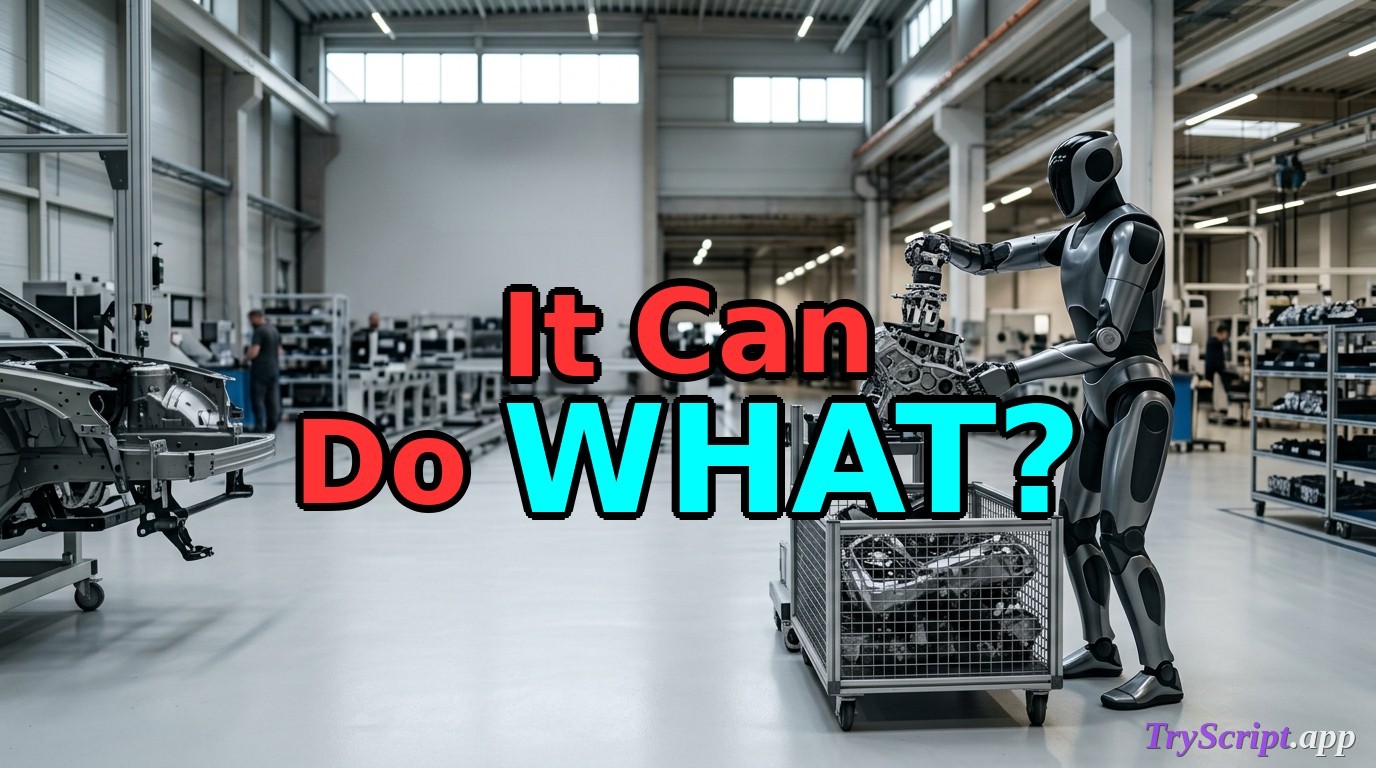
How Electric Atlas Is Revolutionizing Factory Sorting
by @mominmikhail2026-10-02T16:37:16Z
2 views
CRITICAL: Cisco SD-WAN Zero-Day Auth Bypass (CVE-2026-76504)
by @mominmikhail2026-10-02T16:34:11Z
2 views
ShinyHunters Infiltrates Clop: The Dark Web Gang War
by @mominmikhail2026-10-02T05:27:20Z
4 views
Tesla Optimus Gen 3 Hits Massive Fremont Ramp
by @mominmikhail2026-09-27T23:26:54Z
11 views