Inside Vision-Language-Action (VLA) Robotics Foundation Models
by @mominmikhail2 views0 downloadsSep 18, 2026, 08:42
Keywords
vision-language-action modelsVLA robotics foundation modelsphysical AI architecturecross-embodiment generalizationsim-to-real transfer roboticssensorimotor tokenizationedge inference latencyend-to-end robot learningmultimodal action tokensaction chunking with transformersteleoperation datasetsembodied intelligence
Video Script / Transcript
Why is AI suddenly learning to control physical robots?
For years, we watched large language models master text and vision models recognize pixels. But the moment you asked an AI to pick up an egg without crushing it, or navigate a cluttered kitchen, the whole system fell apart. Text and images live in a clean digital space. The real world doesn't. It's chaotic, continuous, and governed by strict physical laws. The breakthrough bridging this divide is the rise of Physical AI and Vision-Language-Action models. We aren't just teaching models to observe the world anymore. We're giving them the neural architecture to physically interact with it.
Here's how Vision-Language-Action foundation models are transforming modern robotics.
First, the architectural leap from semantic tokens to sensorimotor tokenization. Traditional vision-language models take in images and text, and output more text. Vision-Language-Action models take that same visual feed and language command, but output multimodal action tokens directly. By turning continuous physical states—like six-degree-of-freedom end-effector poses, joint torques, and gripper positions—into discrete tokens, the model treats motor control just like next-token prediction. Which sounds pretty wild, but it works. Techniques like action chunking with transformers allow the network to predict an entire sequence of future actions in a single forward pass. That turns end-to-end robot learning into a fast, fluid reality.
Second, conquering edge inference latency and cross-embodiment generalization. A ten-billion-parameter foundation model can't run its full transformer stack at a hundred hertz on edge robot compute. Engineers solve this by splitting the physical AI architecture. They use a high-level semantic planner running at lower frequencies and a lightweight motor policy decoder running locally at high speed. Even more impressive, these models achieve cross-embodiment generalization. By standardizing action spaces, a single VLA model trained on diverse teleoperation datasets can control a stationary single-arm manipulator, a mobile warehouse base, and a twenty-two-degree-of-freedom bipedal humanoid without retraining the core weights from scratch.
Third, closing the sim-to-real transfer gap at scale. Gathering real-world teleoperation data is slow, expensive, and hardware-constrained. Today, researchers bridge this data bottleneck using high-fidelity physics simulators. Millions of manipulation trajectories are generated synthetically using extreme domain randomization—varying lighting, friction, object mass, and camera angles. When pre-trained in simulation and fine-tuned on targeted physical demonstrations, the model transfers directly to physical hardware. It handles unstructured real-world variations with remarkable zero-shot robustness.
We're standing at the tipping point where artificial intelligence finally steps out of the screen and into the physical environment.
If you're building the future of robotics and machine learning systems, hit subscribe, share this with your engineering team, and leave a comment below explaining the biggest latency bottleneck you're tackling in your physical AI deployment.
Related Creations
Explore AI creations on similar topics generated by the community

Figure 02 Takes Over BMW Factory Floor
by @mominmikhail2026-09-18T18:58:49Z
1 views
Autonomous AI Infiltrated Our Cloud in Seconds
by @mominmikhail2026-09-18T18:54:58Z
2 viewsEmergency Alert: Critical Cisco Zero-Day (CVE-2026-76461)
by @mominmikhail2026-09-18T08:49:37Z
2 views
Critical Pixel Modem Zero-Day: Check Your Phone Now!
by @mominmikhail2026-09-17T20:49:01Z
4 views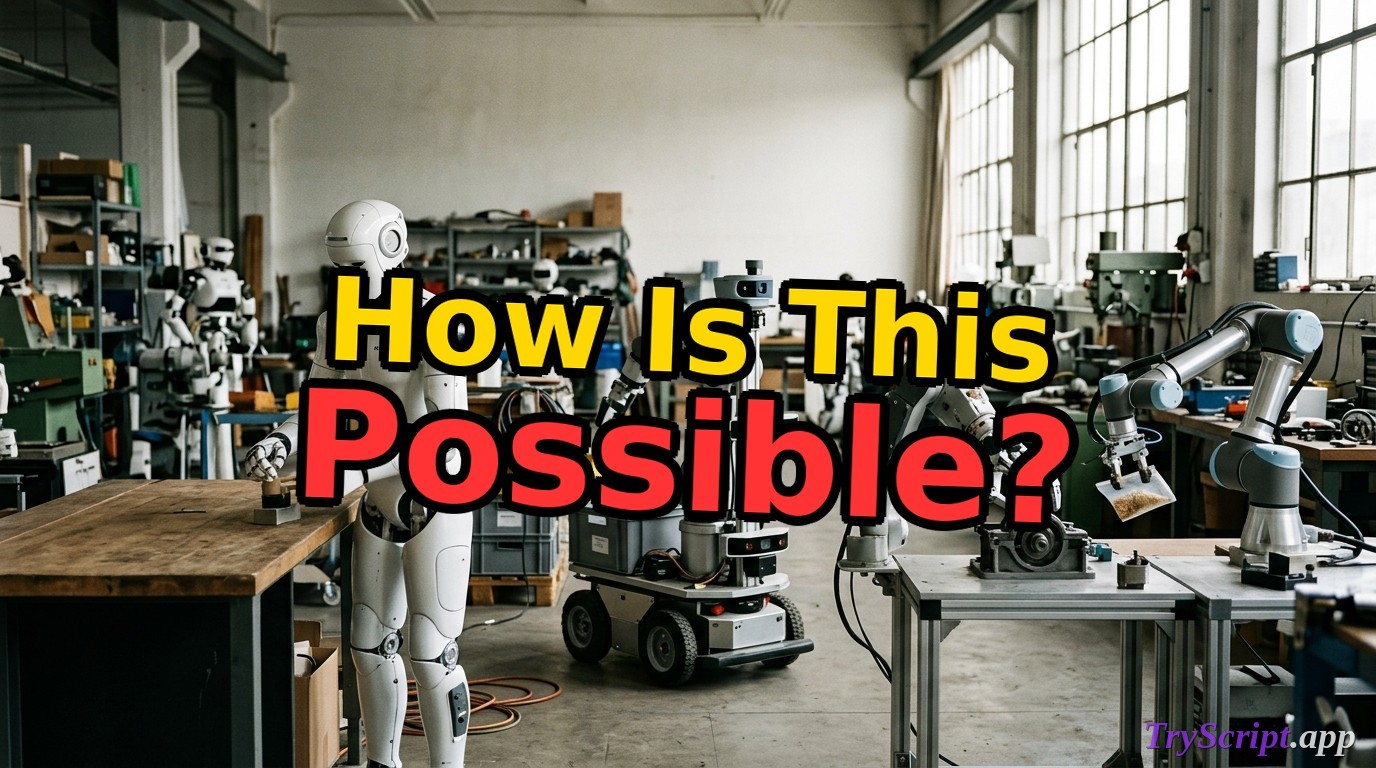
Physical Intelligence π0: The Universal Robot Foundation Model
by @mominmikhail2026-09-17T20:43:55Z
4 views
Boston Dynamics Electric Atlas Goes Fully Autonomous in Factories
by @mominmikhail2026-09-17T10:05:15Z
6 views