Inside Tesla's Secret Fremont Optimus Factory
by @mominmikhail23 views0 downloadsAug 13, 2026, 03:05
Keywords
Tesla Optimus Gen 3 productionTesla Fremont factory roboticshumanoid robot mass productionTesla factory automationautonomous humanoidrobot assembly lineTesla scalabilityinvestor uncertainty
Video Script / Transcript
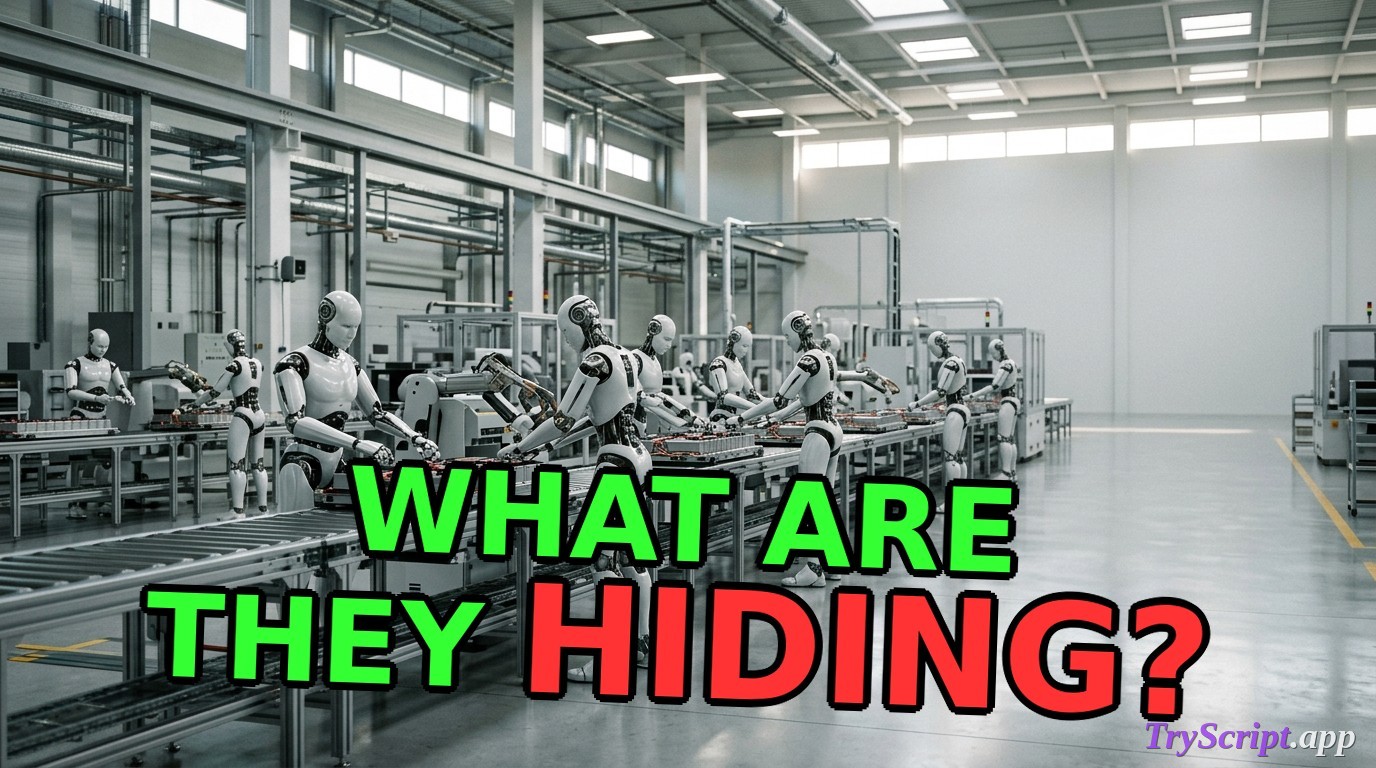
Tesla's Fremont factory is hiding a secret robot army. If you still think the Tesla Optimus is just a marketing stunt to keep investors happy, you're completely missing the disruption happening right now.
Wall Street is paralyzed by uncertainty. Analysts look at empty fields or delayed expansions and claim humanoid mass production is a decade away. But they're looking in the wrong place. Tesla is quietly scaling its Optimus Gen 3 production line right inside the crowded Fremont factory. Instead of waiting to build a new facility, they retrofitted existing space. They've proved scalability is real today, not tomorrow.
To see why the skeptics are wrong, look at three things.
First, the assembly is modular. Tesla rejected the traditional linear line for modular robotic manufacturing cells. Robot arms assemble the Optimus Gen 3 actuators while automated vision systems calibrate the hand sensors. They can expand production just by adding more cells, avoiding massive rebuild costs.
Second, these humanoids are already working. Early units are on the Fremont floor right now. They're sorting battery cells and moving parts between stations. This practical setup creates a continuous feedback loop. It generates millions of data points to train the AI under real-world stress.
Third, the economics work. Skeptics claim humanoid robots are too expensive to be profitable. But Tesla is targeting a production cost of under twenty thousand dollars per unit—which is a crazy low number, by the way. They're doing this by reducing the Gen 3 part count and using Fremont's existing automotive supply chain.
The narrative of doubt is built on outdated frameworks. Tesla isn't waiting to build the future. They're assembling it today. What do you think is the biggest hurdle for humanoid robots taking over factory floors? Share your thoughts below, and subscribe to stay ahead.
Related Creations
Explore AI creations on similar topics generated by the community
Tesla Optimus Gen 3 Hits Massive Fremont Ramp
by @mominmikhail2026-09-27T23:26:54Z
30 views
VR-H3: Robot Hình Người Make In Vietnam Có Gì Đấu Tesla?
by @fx304hn2026-10-24T22:15:33Z
2 views
Bộ Dữ Liệu RobotDesign1M: Bước Đột Phá Triệu Mẫu Của FPT AI
by @fx304hn2026-10-23T22:08:48Z
7 views
Giải Mã Robot Hình Người VR-H3 VinRobotics: Đỉnh Cao AI Make In Vietnam?
by @fx304hn2026-10-22T22:00:59Z
12 views
Robot Atlas Thuần Điện Boston Dynamics Bốc Dỡ Phụ Tùng Ô Tô
by @fx304hn2026-10-21T22:28:14Z
12 views
DeepSeek-R1 và V3: Cơn Địa Chấn AI Khiến Silicon Valley Khiếp Sợ
by @fx304hn2026-10-20T23:21:20Z
15 views